How Does Instrument Separation Occur?
Root canal therapy involves the use of various specialized dental instruments. These instruments come in many forms—straight, curved, spiral, or barbed—each designed to remove the dental pulp, then shape and clean the root canal system for filling. However, if these instruments encounter significant resistance or excessive torque during use, they can fracture.
This resistance primarily originates from within the root itself. The root canal system of every tooth is complex and highly variable. Some canals are extremely narrow, others have sharp or unusual curvatures, and some may be blocked by calcifications or have irregular walls. These anatomical challenges are often difficult to detect from the tooth’s surface or even on a standard X-ray, thus increasing the complexity and risk of the procedure.
In recent years, engine-driven instruments, such as Nickel-Titanium (NiTi) rotary systems, have become common in clinical practice. They offer greater efficiency than hand instruments and can shorten treatment time, making them a favorite among dentists. However, these instruments operate at high speeds with significant cutting force. When they encounter unexpected resistance within the canal, they too can separate.
Furthermore, a patient’s sudden movements due to pain, fear, or anxiety during treatment can be very dangerous and can easily lead to an instrument fracturing within the canal. This event is commonly referred to as a “broken file” or “separated instrument.”
The Critical Question: To Retrieve or Not to Retrieve?
Does a separated instrument always need to be removed? The answer is not necessarily.
The decision to retrieve a separated instrument depends on a careful assessment of its location and length, its potential impact on the treatment outcome, and the difficulty of removal. In many situations, a separated fragment can be bypassed and incorporated as part of the final root canal filling, achieving a successful long-term result.
However, if the clinician determines that the fragment will significantly compromise the prognosis, then it should be removed. It is crucial to understand that retrieving a separated instrument is a highly technique-sensitive procedure with inherent risks. Even with specialized equipment and in the hands of an experienced specialist, success is not guaranteed. Therefore, the clinician must consider the tooth’s condition and the patient’s overall situation to determine the most appropriate management plan.
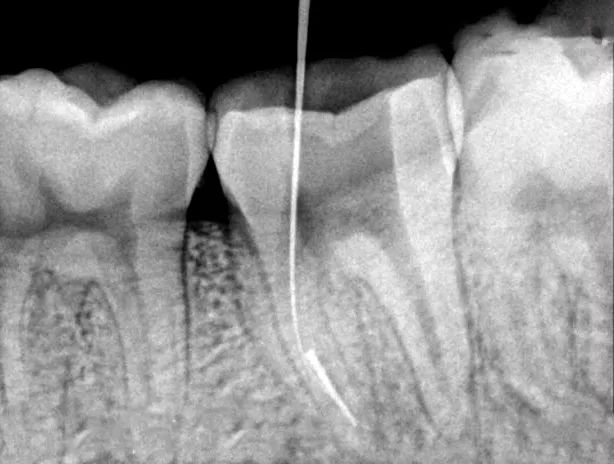
The first step is always to take a radiograph to determine the exact location and length of the fragment and its anatomical relationship. If the separation occurred in a more coronal part of the canal, it can often be removed. However, if the fragment is located deep within the canal or is lodged past a significant curvature, retrieval becomes more challenging. The prerequisite for any retrieval attempt is the ability to visualize the separated fragment.
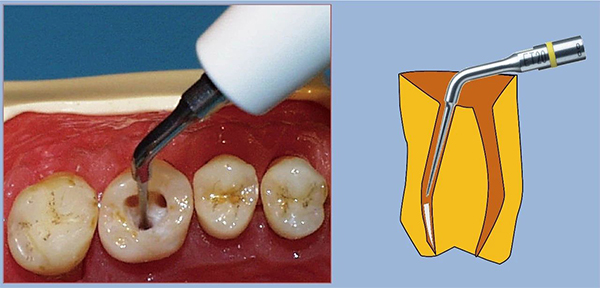
When retrieval is necessary, the mainstream and most effective approach is ultrasonic instrument retrieval, specifically using the Satelec method.
Advantages of the Satelec Ultrasonic Retrieval Method
This technique offers several distinct advantages that make it superior to other methods:
1. Asymmetrical Dentin Removal
This allows the clinician to selectively and precisely remove dentin from around the instrument to create a “staging platform” or trough, without unnecessarily weakening the root structure. This targeted approach preserves vital tooth structure.
2. Direct Visualization Under the Microscope
The slim profile of Satelec ultrasonic tips allows for an unobstructed view when working under a dental operating microscope. This direct visualization is critical for precise and minimally invasive dentin removal, dramatically reducing the risk of iatrogenic errors such as perforation.
3. Pre-bendable Tips
Many specialized Satelec retrieval tips are designed to be safely pre-bent. This flexibility allows the tip to navigate around canal curvatures, providing access to fragments that are lodged in difficult-to-reach areas of the root system.
These features combine to make the Satelec ultrasonic technique the gold standard for predictable and safe instrument retrieval.