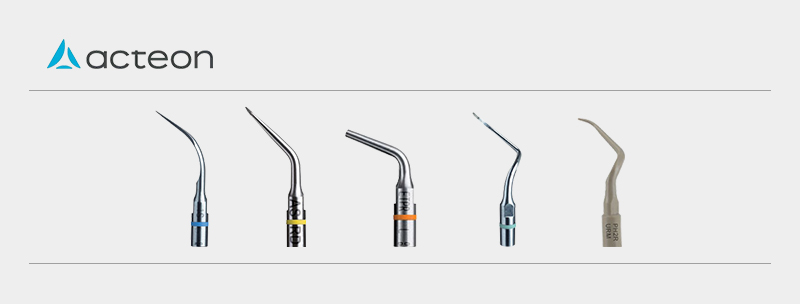
Green-ring tips:
Low power, low amplitude. Suitable for delicate care on sensitive surfaces, including subgingival periodontal maintenance, implant maintenance, and maintenance of porcelain-fused-to-metal (PFM) or ceramic restorations.
Tip models: H1, H2L, H2R, H3, PH1.
Operate within the green zone, scale positions 1–4.
Yellow-ring tips:
Medium power, high amplitude. Intended for fine tips used in tooth/root canal procedures such as canal irrigation, foreign-body removal, and root canal backfilling.
Root canal irrigation tip sizes: K10-21, K10-25, K15-21, K15-25, K25-21, K25-25, K30-21, K30-25.
ET20, ET20D: Removal of posts in the coronal one-third, fractured instruments, residual filling materials, and other foreign bodies.
ET25: Removal of foreign bodies in the apical one-third of the canal.
ET40, ET40D: Removal of foreign bodies in deep portions of the canal.
ETBD: Locating calcified canal orifices, etc.
Must operate within the yellow zone.
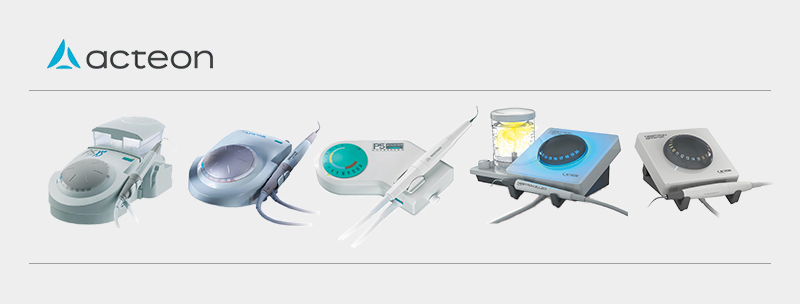
For canal irrigation: tabletop (standalone) scaler scale 6–7; integrated (built-in) scaler scale 3–4.
For ET series tips used in endodontic retreatment: tabletop scaler scale 6–10; integrated scaler scale 3–5.
Blue-ring tips:
High power, high amplitude. Used for supragingival scaling, cavity preparation, and shoulder (finish line) preparation.
Supragingival scaling: 1#, 1S, 2#, 10P. Cervical scaling: PEL, PFR. Subgingival shoulder preparation: PM1. Dentin removal to refine the shoulder: PM3.
Must operate within the blue zone.
Tabletop scaler scale 11–15; integrated scaler scale 6–8.
Notes:
- Set the operating power within the color-marked working zone. Operating beyond the color-coded range increases the risk of tip fracture.
- Place the tip in the operative field before switching on the power. Otherwise, the tip is prone to fracture, especially during subgingival debridement and root canal irrigation.
- During endodontic retreatment, do not lever or pry with the tip; otherwise, the tip is likely to fracture.